
MAINTENANCE GUIDE
5 Signs Your High Pressure Pump Needs Replacement
Know the warning signals before they cost you more than a new pump.
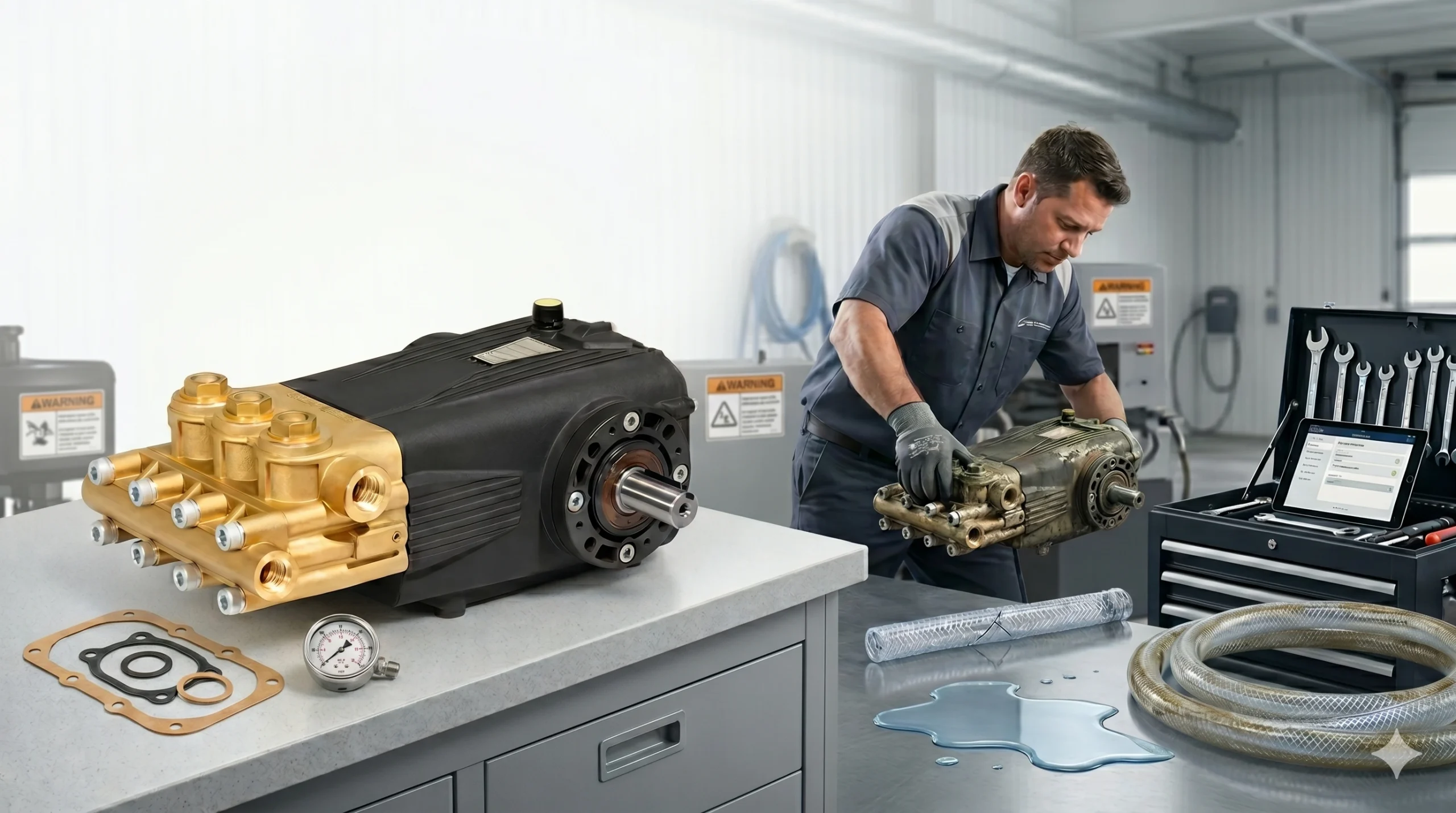
A high pressure pump is the heart of any industrial cleaning, water jetting, or surface preparation system. When it’s running well, operations are smooth and efficient. When it starts to fail — often without obvious warning — the consequences range from reduced productivity to complete equipment breakdown.
The good news: your high pressure pump almost always gives you advance notice before it fails completely. Knowing how to read those signals gives you time to plan a replacement on your schedule, not during an emergency shutdown.
In this guide, we walk through the 5 most critical signs that your high pressure pump needs replacement — and what to do about each one.

1. Significant Drop in Pressure Output
The most obvious sign of a failing high pressure pump is a measurable and consistent loss of pressure. If your system is rated at 500 bar but you’re now only achieving 350 bar under normal operating conditions, something internal has degraded.
The most common culprits behind pressure loss include:
- Worn plunger seals or packing — allowing fluid to bypass instead of building pressure
- Damaged or stuck inlet/outlet valves — preventing proper pressure cycling
- Scored or corroded plungers — reducing the pump’s ability to compress fluid effectively
- Air ingestion from a failing inlet line — causing cavitation and pressure fluctuation
While a single worn seal can be replaced cost-effectively, pressure loss that returns shortly after repairs — or involves multiple components simultaneously — is a strong indicator that the pump has reached the end of its serviceable life.
WARNING: If pressure drops by more than 20% from rated output and does not recover after a basic service, plan for full pump replacement.
2. Visible Leaks Around Seals and Fittings
All high pressure pumps develop minor weeping around seals over time — this is normal and manageable with routine maintenance. However, active leaking from multiple points, or leaks that reappear rapidly after seal replacement, signals a more serious structural problem.
Pay particular attention to:
- Leaks at the pump head — indicating cracked or warped manifold components
- Leaks at high-pressure fittings that recur even after re-torquing
- Oil weeping from the crankcase — pointing to internal seal degradation
- Water contamination in the oil reservoir — a sign of catastrophic seal failure
Water-in-oil contamination is particularly serious. It accelerates wear on bearings and the crankshaft, and if left unaddressed, can cause irreversible internal damage that makes the pump uneconomical to repair.
WARNING: Water contamination in pump oil is a critical failure warning. Shut down immediately and assess repair costs against replacement value.
TIP: Check oil colour at every service. Milky-white or grey oil indicates water ingress from a failed internal seal.
3. Unusual Noise or Excessive Vibration
A well-maintained high pressure pump operates with a consistent, rhythmic sound. Changes in that sound profile — knocking, rattling, squealing, or grinding — are your pump communicating that something has changed internally.
Common noise-related failure patterns include:
- Knocking or banging — often caused by cavitation, which damages plungers and valve seats over time
- Metallic grinding — bearing failure within the crankcase assembly
- High-pitched squealing — dry-running or lubrication failure
- Irregular pulsation — uneven valve behaviour or damaged seating surfaces
Excessive vibration is equally important to monitor. Vibration beyond normal operating levels stresses pipe connections, high-pressure hoses, and fittings — causing secondary failures throughout your system. It also accelerates wear on the pump’s own internal components.
If abnormal noise and vibration persist after inspecting and replacing suspect components, the pump’s core mechanical integrity may be compromised. At this stage, continued operation risks sudden failure and potential safety hazards to operators.
WARNING: Knocking sounds combined with pressure loss almost always indicate cavitation damage — a progressive condition that worsens with every operating hour.
4. Frequent Unexpected Shutdowns or Overheating
Thermal protection systems on industrial high pressure pumps are designed to shut the unit down before heat causes internal damage. An occasional trip in extreme conditions is expected. Frequent or unpredictable shutdowns are not — they indicate the pump is working harder than it should be to deliver output.
Overheating and unplanned shutdowns are typically caused by:
- Worn seals forcing the pump to work harder to maintain pressure
- Blocked or fouled unloader valve — preventing proper bypass during idle operation
- Insufficient cooling water flow to the pump head
- Oil degradation or incorrect viscosity causing increased internal friction
- Oversized load from downstream restriction — often from clogged nozzles or blocked lines
While some of these causes are addressable through maintenance, a pump that repeatedly trips its thermal protection after servicing has typically developed internal inefficiencies that maintenance alone cannot resolve. Worn internal surfaces cause the pump to consume significantly more energy to generate the same output pressure — shortening each operational cycle before heat becomes a limiting factor.
TIP: Track shutdown frequency. If thermal trips increase from once a quarter to once a week despite proper maintenance, replacement planning should begin immediately.
5. Pump Has Exceeded Its Service Life
Even a high pressure pump that shows no obvious failure symptoms today can become an operational liability when it has exceeded its design service life. Industrial-grade plunger pumps are typically engineered for 5 to 10 years of service under proper operating conditions. After this point, the cumulative wear on internal components makes failures increasingly likely and repairs increasingly expensive.
When evaluating an ageing high pressure pump, consider these factors together:
- Total operating hours relative to the manufacturer’s recommended service life
- Frequency and cost of maintenance over the past 12 months compared to previous years
- Availability of genuine spare parts — older pump models are often discontinued
- Whether the pump meets current efficiency, safety, and compliance standards
- The risk cost of unplanned downtime in your specific operational context
Proactive replacement of an aged pump during a planned maintenance window is almost always significantly cheaper than emergency replacement following a catastrophic failure — particularly when you factor in lost production time, rush freight on parts, and emergency service call costs.
Modern high pressure pumps from Jetmaster also offer improvements in energy efficiency, noise reduction, and operator safety over older models — meaning a replacement investment can deliver measurable operational benefits beyond simply restoring lost capacity
TIP: If your pump is over 7 years old and requires service more than twice a year, start evaluating replacement options now — before the decision is made for you.
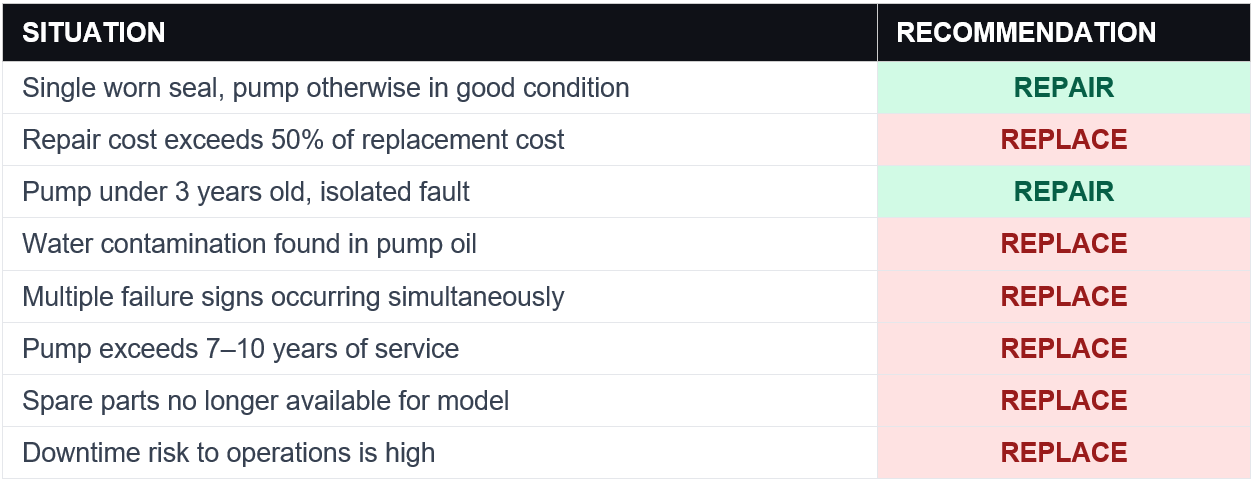
Repair vs. Replace: A Quick Decision Guide
Use this reference to help make the call. When multiple ‘Replace’ indicators apply simultaneously, replacement is almost always the right choice.
Act Before the Pump Acts for You
A failing high pressure pump rarely fails without warning. Pressure loss, leaks, abnormal noise, overheating, and advancing age are all signals worth taking seriously — and each one becomes more costly the longer it goes unaddressed.
The difference between a planned pump replacement and an emergency one is not just financial. It’s the difference between controlled downtime and unexpected operational disruption that can affect delivery schedules, safety, and client commitments.
Jetmaster’s range of industrial high pressure pumps — engineered in Italy and assembled in Singapore — are built to handle the most demanding applications, from ship cleaning and pipeline descaling to surface preparation and industrial hygiene. If your current pump is showing any of the five signs above, our specialists are available to assess your requirements and recommend the right replacement.
FAQ
How do I know if my high pressure pump needs replacement?
The key indicators are a consistent drop in pressure output, active leaks that recur after repair, unusual operating noise or vibration, frequent thermal shutdowns, and a pump age of 7 years or more. When two or more of these occur together, replacement is almost always more cost-effective than ongoing repair.
How long does a high pressure pump typically last?
An industrial-grade high pressure pump that is properly maintained will typically last between 5 and 10 years. Regular servicing — including seal replacement, valve inspection, and oil changes — can push that figure toward the upper end. Pumps used in highly abrasive applications or with poor-quality water supply may have shorter service lives.
Is it better to repair or replace a high pressure pump?
If the repair cost is less than 30–40% of the replacement cost and the pump is under 5 years old with an isolated fault, repair is usually sensible. Once repair costs approach or exceed 50% of replacement cost — or if the pump shows multiple simultaneous failure signs — replacement offers better long-term value and operational reliability.
What causes a high pressure pump to lose pressure?
plunger surfaces, or air ingestion from a failing inlet connection. Cavitation — caused by inadequate water supply to the pump inlet — is another common cause that progressively worsens over time if not corrected.
Can I continue using a high pressure pump that is leaking?
Minor weeping from seals can sometimes be monitored temporarily during planned maintenance cycles, but active leaks — especially those involving oil, or leaks at the pump head — should be addressed immediately. Continuing to operate a pump with significant leaks accelerates internal wear, creates safety risks, and increases the likelihood of sudden catastrophic failure.
Explore Related Articles

Author Bio
Jetmaster

Jetmaster is a Singapore-based cleaning equipment brand established in 1991, specialising in high-pressure cleaning solutions for domestic, commercial and industrial applications.
With strong engineering capabilities and a focus on reliability, Jetmaster offers high-pressure washers, high-pressure pumps, vacuum cleaners and floor blowers for industries including marine, construction, automotive, manufacturing and agriculture.
Jetmaster is committed to delivering practical, efficient and reliable cleaning solutions backed by technical expertise and after-sales support.