
ARTICLE
What Is a Floor Blower? How It Works & Where It Is Used
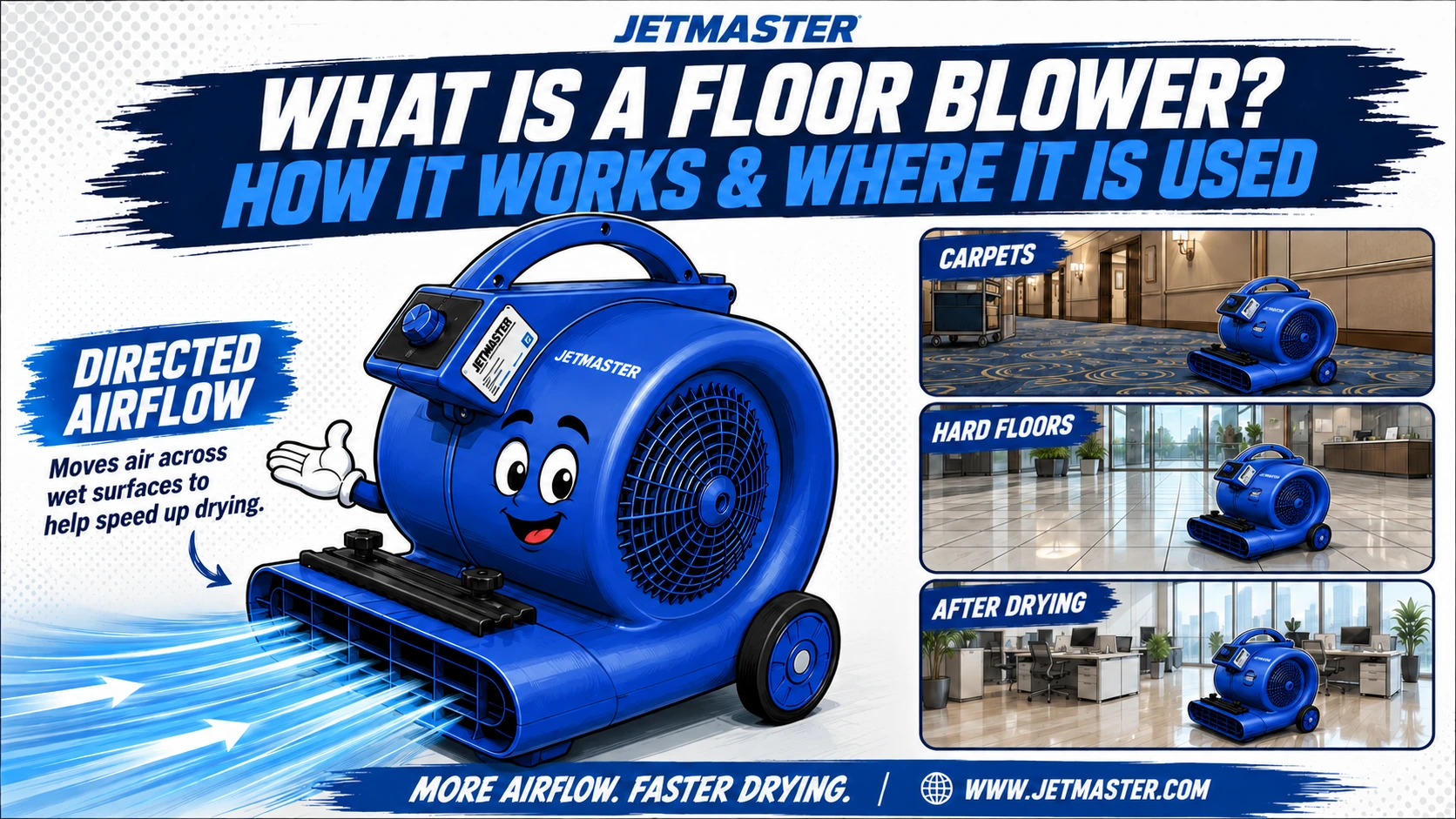
A floor blower also called a floor drying fan or industrial air mover is a piece of equipment that uses a high-speed motor to force a concentrated stream of air across a floor, carpet, or wet surface. Unlike a standard fan, it’s built to speed up evaporation and drying rather than simply cool a room, which is why it’s a common sight in hotels, warehouses, F&B outlets, and cleaning operations across Singapore.
This guide breaks down what a floor blower actually is, how it works, how it differs from a regular fan, and where businesses in Singapore typically put one to use.
What Is a Floor Blower?
A floor blower is a compact, motor-driven appliance designed to move a high volume of air in a focused direction, usually low across a floor surface. It’s built around a powerful motor connected to an enclosed impeller, which pulls in air and pushes it out through a narrow outlet at high velocity.
That focused airflow does two jobs at once:
- Speeds up drying by increasing evaporation on wet floors, carpets, and other surfaces
- Improves air circulation, which helps clear odours, dust, and light fumes from a space
Because Singapore’s climate is humid year-round, moisture on tiled or vinyl flooring doesn’t evaporate on its own nearly as fast as it would in a drier climate. That’s the main reason floor blowers are a standard piece of equipment for cleaning crews, facilities teams, and hospitality operators here — mopped or washed floors simply take longer to dry without forced air.
How Does a Floor Blower Work?
A floor blower works through three core components:
- Motor — drives the internal impeller at high speed. The stronger the motor, the more air the unit can move.
- Impeller (fan blades) — enclosed within the housing, the impeller uses centrifugal force to draw air in and accelerate it outward, rather than simply pushing air the way an open desk fan does.
- Directional outlet — channels that accelerated air into a narrow, focused stream instead of dispersing it across a wide area.
The result is a stream of air that moves faster and more forcefully than a typical fan, aimed precisely at the wet surface. This raises the rate of evaporation, so a floor that might air-dry in an hour can often be dried in a fraction of that time.
Most commercial-grade floor blowers, including Jetmaster’s JMB106-90, also include:
- Variable speed control — so airflow can be adjusted to the task and the space, rather than running at full power for every job
- Multi-angle positioning — so the airflow can be directed exactly where it’s needed, whether that’s flat across a floor or angled toward a wall or corner
- Robust, heavy-duty construction — built to withstand repeated daily use in commercial and industrial settings, not just occasional household use
Floor Blower vs. Floor Fan: What’s the Difference?
The terms get used interchangeably, but there’s a real difference between a floor blower and a standard floor fan.
In short: a floor fan is built to make a room feel more comfortable. A floor blower is built to do a job get moisture off a surface as quickly as possible.
| Floor Blower | Floor Fan | |
| Airflow | Focused, high-velocity stream | Broad, general circulation |
| Primary purpose | Drying wet surfaces, clearing odours/fumes | Cooling people, general ventilation |
| Typical setting | Commercial, industrial, cleaning operations | Homes, offices |
| Noise & power use | Generally higher | Generally lower |
Where Is a Floor Blower Used?
Floor blowers are standard equipment across a wide range of commercial and industrial settings in Singapore, including:
- Hotels and hospitality — drying lobby and corridor floors after mopping, and speeding up carpet drying after cleaning or shampooing, without shutting guest areas for long periods
- F&B outlets, hawker centres and food courts — drying kitchen and dining floors quickly to reduce slip-and-fall risk during service hours
- Shopping malls and commercial buildings — drying high-traffic lobbies and walkways after routine cleaning
- Warehouses and logistics facilities — general ventilation and drying after floor washing or minor water leaks
- Construction and renovation sites — drying freshly cleaned or water-affected floors before flooring, tiling, or painting work continues
- Janitorial and cleaning companies — a core tool for professional cleaning crews servicing commercial clients, used after every wet-mopping or carpet-extraction job
- Facilities and property management — quick response to minor leaks, spills, or water ingress to limit the risk of mould and mildew forming on affected flooring
Anywhere floors are cleaned regularly or exposed to spills and moisture, a floor blower helps cut the downtime between “just cleaned” and “safe and dry to walk on.”
Need a floor blower for your business?
Jetmaster’s JMB106-90 delivers powerful, adjustable airflow built for commercial and industrial drying tasks across Singapore
Frequently Asked Questions (FAQ)
Is a floor blower the same as an air mover?
Yes. “Floor blower,” “floor drying fan,” and “air mover” all refer to the same type of equipment — a motor-driven unit that produces focused, high-velocity airflow to dry surfaces and improve air circulation.
Can a floor blower be used for ventilation, not just drying?
Yes. Because it moves a high volume of air, a floor blower can also be used to improve general air circulation, clear light fumes or odours, and support ventilation in enclosed commercial spaces.
Do floor blowers work on carpets as well as hard floors?
Yes. Floor blowers are commonly used after carpet cleaning or extraction to speed up drying time, in addition to hard flooring like tile, vinyl, and concrete.
What should I look for when choosing a floor blower for commercial use?
For regular commercial use, prioritise a robust, heavy-duty build, variable speed control so airflow can be matched to the task, and multi-angle positioning so air can be directed precisely where it’s needed.

Author Bio
Jetmaster

Jetmaster is a Singapore-based cleaning equipment brand established in 1991, specialising in high-pressure cleaning solutions for domestic, commercial and industrial applications.
With strong engineering capabilities and a focus on reliability, Jetmaster offers high-pressure washers, high-pressure pumps, vacuum cleaners and floor blowers for industries including marine, construction, automotive, manufacturing and agriculture.
Jetmaster is committed to delivering practical, efficient and reliable cleaning solutions backed by technical expertise and after-sales support.