
ARTICLE
How to Dry Wet Floors and Carpets Faster in Commercial Buildings
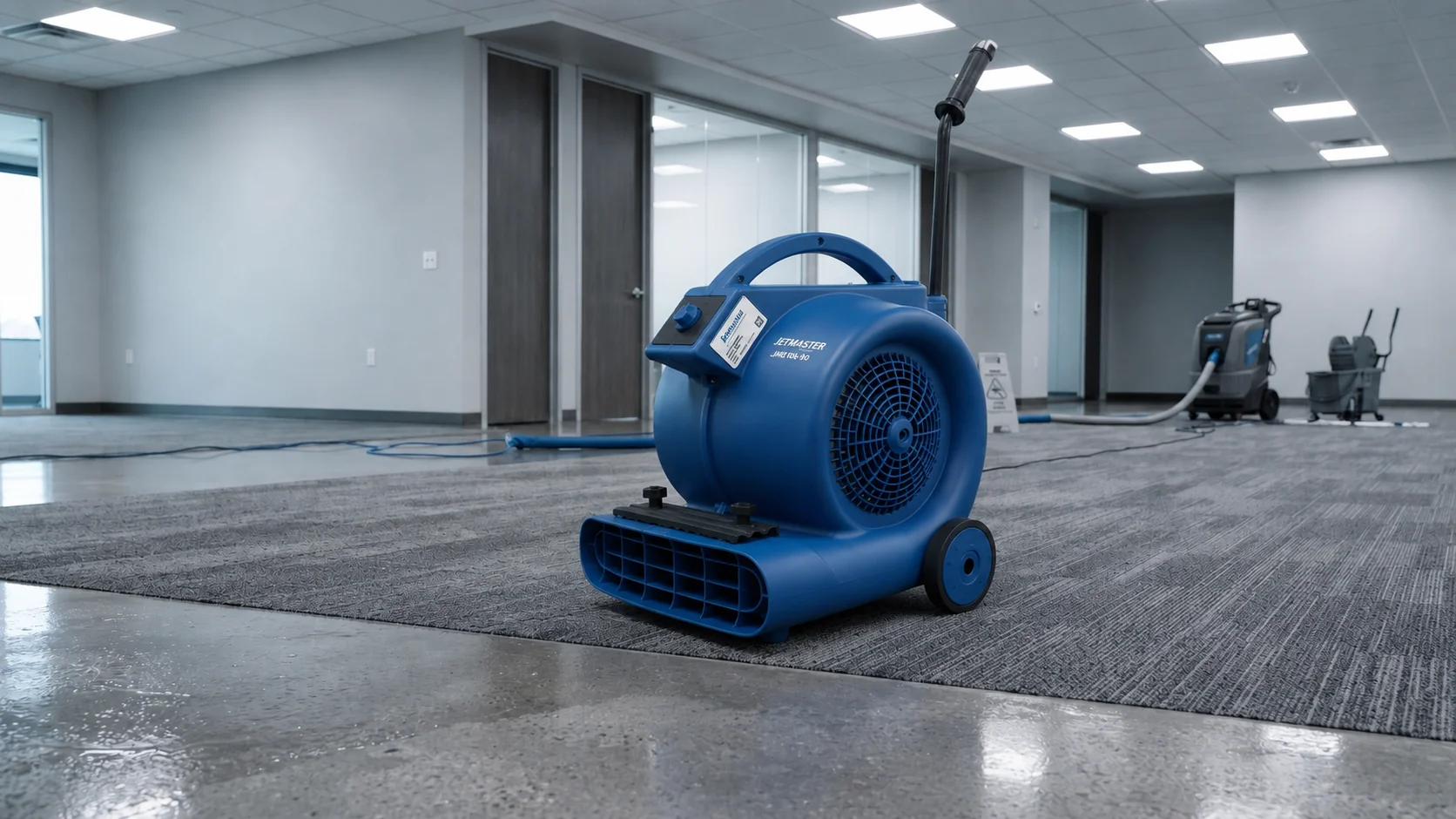
Wet floors and carpets can create operational problems in hotels, offices, warehouses and other commercial facilities. After routine cleaning, accidental spills or water leaks, simply waiting for a surface to air-dry may take too long – especially in large indoor spaces with limited air circulation.
One practical way to accelerate the process is to increase airflow across the wet surface using a floor blower. However, airflow is only one part of effective drying. The amount of standing water, surface material, humidity, ventilation and positioning of the equipment can all affect how quickly an area dries.
This guide explains practical steps facility and cleaning teams can take to improve floor and carpet drying.
Why Do Some Floors Take So Long to Dry?
Drying happens when moisture on or within a surface evaporates into the surrounding air. Several conditions can slow this process:
• Limited air circulation
• High indoor humidity
• Large amounts of standing water
• Absorbent materials such as carpet
• Low ventilation
• Large floor areas
• Airflow that is not reaching the wet surface
This is why simply opening a door or using a conventional fan may not always provide the drying performance required for commercial cleaning operations.
1. Remove Standing Water First
A floor blower should not be treated as a replacement for water extraction. If there is a significant amount of standing water, remove as much of it as possible before beginning the drying process.
Depending on the situation, this could involve a wet vacuum, mop or appropriate water-extraction equipment. Once excess water has been removed, airflow can then help accelerate evaporation of the remaining moisture.
2. Direct Air Across the Wet Surface
Positioning matters. Rather than directing airflow randomly into the room, position the blower so that moving air passes across the wet floor or carpet.
This helps move moisture-laden air away from the surface and allows surrounding air to replace it. For a small wet area, one strategically positioned floor blower may be sufficient. Larger areas may require several units positioned at different locations.
3. Adjust the Airflow for the Application
Not every drying job requires the same amount of airflow. A large warehouse floor may benefit from stronger airflow, while drying a smaller carpeted area in a hotel may require a different setup. Adjustable airflow therefore gives operators greater flexibility.
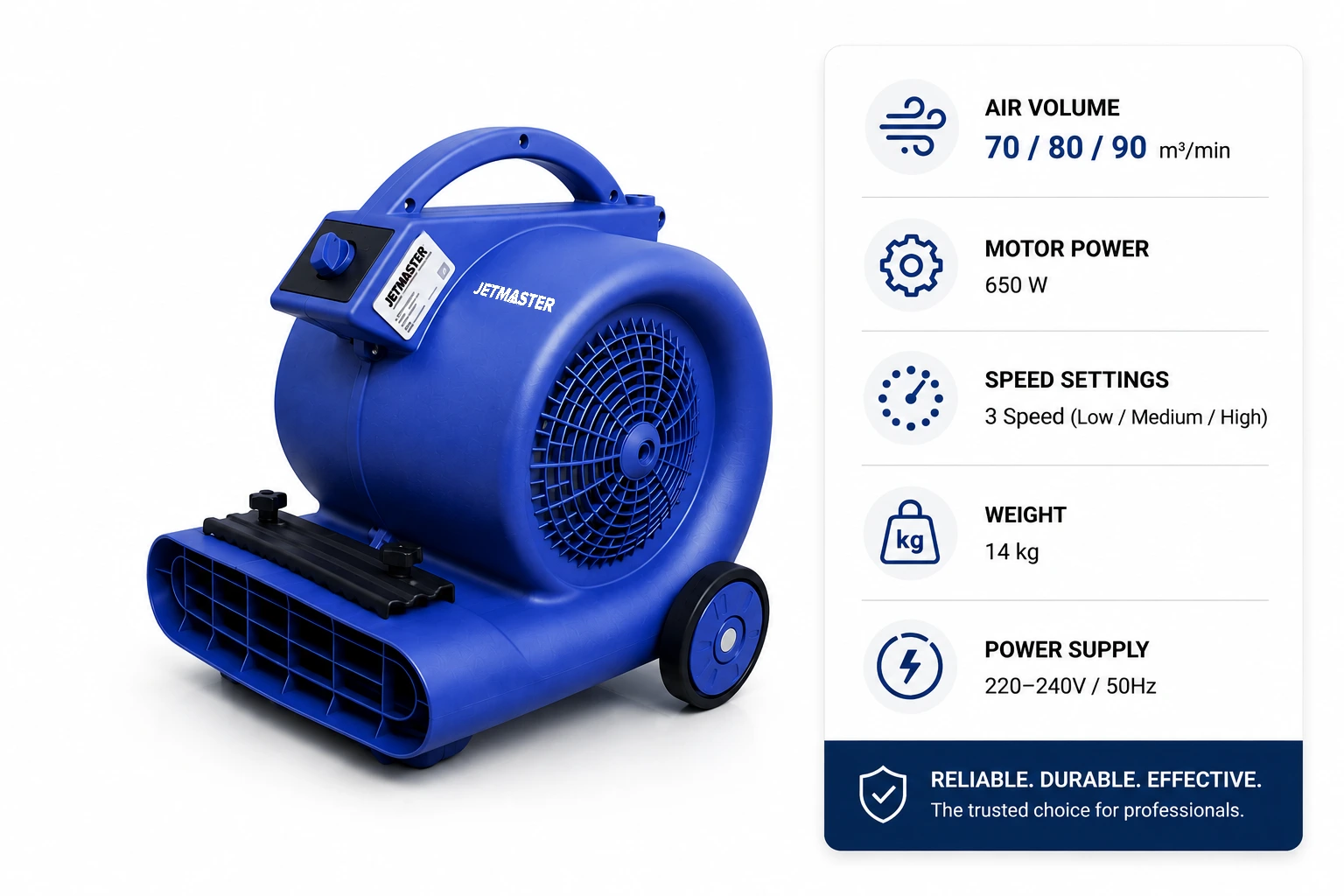
The Jetmaster JMB106-90 Floor Blower provides three selectable airflow levels:
• Low – 70 m³/min
• Medium – 80 m³/min
• High – 90 m³/min
♦ JETMASTER TIP♦
Remove standing water first, then position the floor blower so airflow travels across the wet surface rather than simply upwards into the room. For larger areas, multiple units may be positioned to improve air movement.
4. Consider the Surface You Are Drying
- Carpet
Carpet can retain moisture within its fibres and underlying layers. After water extraction or carpet cleaning, directing airflow across the carpet surface can help accelerate evaporation. For heavily saturated carpets, additional extraction or professional restoration equipment may be required. - Tile
Water normally remains on the surface of tiles rather than being absorbed. Removing standing water followed by targeted airflow can therefore help shorten drying time. - Concrete
Concrete is porous and may retain moisture. Drying time can vary depending on how wet the surface is, ambient humidity and ventilation. For substantial water exposure, airflow alone may not be sufficient.
5. Improve Air Circulation Around the Area
Moving air across the floor is useful, but the moisture that evaporates still needs somewhere to go. Where appropriate, improving ventilation can help move humid air away from the drying area.
For enclosed or particularly humid environments, professional drying operations may combine air movers with dehumidification equipment. This is particularly relevant for water-damage restoration, where removing moisture from both surfaces and surrounding air may be necessary.
Where Are Floor Blowers Commonly Used?
- Hotels & Hospitality
Hotels frequently clean carpets in guest rooms, corridors, ballrooms, function rooms, lobbies and common areas. A portable floor blower can be moved between areas after cleaning to help accelerate carpet and floor drying, particularly when rooms or facilities need to return to service quickly.
- Building & Facility Maintenance
Facility teams may need to clean large floor areas during routine maintenance. Increasing airflow after cleaning can reduce the amount of time that areas remain wet. Portable blowers also allow maintenance teams to move the equipment to wherever drying is required.
- Warehouses & Industrial Facilities
Warehouses commonly have large concrete floor areas. After cleaning, maintenance or minor water incidents, targeted airflow can be directed towards individual work zones rather than waiting for the entire area to dry naturally.
- Water Damage Restoration
Leaks and other unexpected water incidents can leave carpets and floors wet. Floor blowers can form part of the drying process by increasing airflow across affected surfaces. Serious flooding or water damage should be professionally assessed, as extraction, dehumidification and moisture measurement may also be necessary.
- Events & Venues
Event halls and exhibition spaces often operate under tight turnaround schedules. Spills or cleaning can leave floors wet, so portable floor blowers can be deployed to selected areas and moved again once drying is complete.
Floor Blower vs Normal Fan
| Consideration | Normal Fan | Floor Blower |
| Primary purpose | Personal comfort / general circulation | Surface drying and targeted airflow |
| Air direction | General | Targeted |
| Floor positioning | Limited | Designed for floor-level use |
| Portability | Varies | Typically portable |
| Commercial drying | Not the primary purpose | Designed for drying applications |
| Airflow control | Depends on model | Multiple settings may be available |
What Should You Look for in a Commercial Floor Blower?
- Airflow
Check the volume of air the machine can move. Larger drying areas may require greater airflow or multiple machines.
- Multiple Speed Settings
Variable airflow gives operators greater flexibility for different environments.
- Portability
Handles and wheels are useful when equipment needs to move between hotel rooms, warehouse zones or different floors of a building.
- Power Cable Length
A longer cable can provide additional flexibility in large commercial spaces.
- Noise
Noise becomes particularly important when equipment is used around occupied offices, hotels, hospitals or other public environments.
- Product Support
For professional equipment, consider technical support and spare-parts availability in addition to the initial purchase price.
JMB106-90 Floor Blower for Commercial Drying
The Jetmaster JMB106-90 is designed as a compact, portable floor blower with adjustable three-speed airflow for drying carpets, rugs, tile, concrete and other applications.
| Airflow | 70 / 80 / 90 m³/min |
| Output Flow | 650W |
| Speed | 3 adjustable settings |
| Maximum Sound Level | 60 dB(A) |
| Power Cord | 10m |
| Power Supply | 220-240V / 50hz |
Need Faster Floor or Carpet Drying?
Discover the Jetmaster JMB106-90 Floor Blower for commercial cleaning, facility maintenance and floor-drying applications.
Frequently Asked Questions (FAQ)
Can a floor blower be used to dry carpet?
Yes. A floor blower can direct airflow across wet carpet to help accelerate evaporation after cleaning. For heavily saturated carpet, water extraction and professional drying methods may also be required.
Can a floor blower be used on tile and concrete?
Yes. Floor blowers can assist with drying hard surfaces such as tile and concrete. Drying time will depend on the amount of water, humidity, ventilation and the surface condition.
Is a floor blower the same as an air mover?
The terms are often used interchangeably for portable equipment designed to move a high volume of air for drying or ventilation
How much airflow does the Jetmaster JMB106-90 provide?
The JMB106-90 provides three selectable flow rates: 70, 80 and 90 m³/min.
Where can a commercial floor blower be used?
Typical applications include hotels, offices, warehouses, supermarkets, restaurants, healthcare facilities and other commercial spaces.

Author Bio
Jetmaster

Jetmaster is a Singapore-based cleaning equipment brand established in 1991, specialising in high-pressure cleaning solutions for domestic, commercial and industrial applications.
With strong engineering capabilities and a focus on reliability, Jetmaster offers high-pressure washers, high-pressure pumps, vacuum cleaners and floor blowers for industries including marine, construction, automotive, manufacturing and agriculture.
Jetmaster is committed to delivering practical, efficient and reliable cleaning solutions backed by technical expertise and after-sales support.